
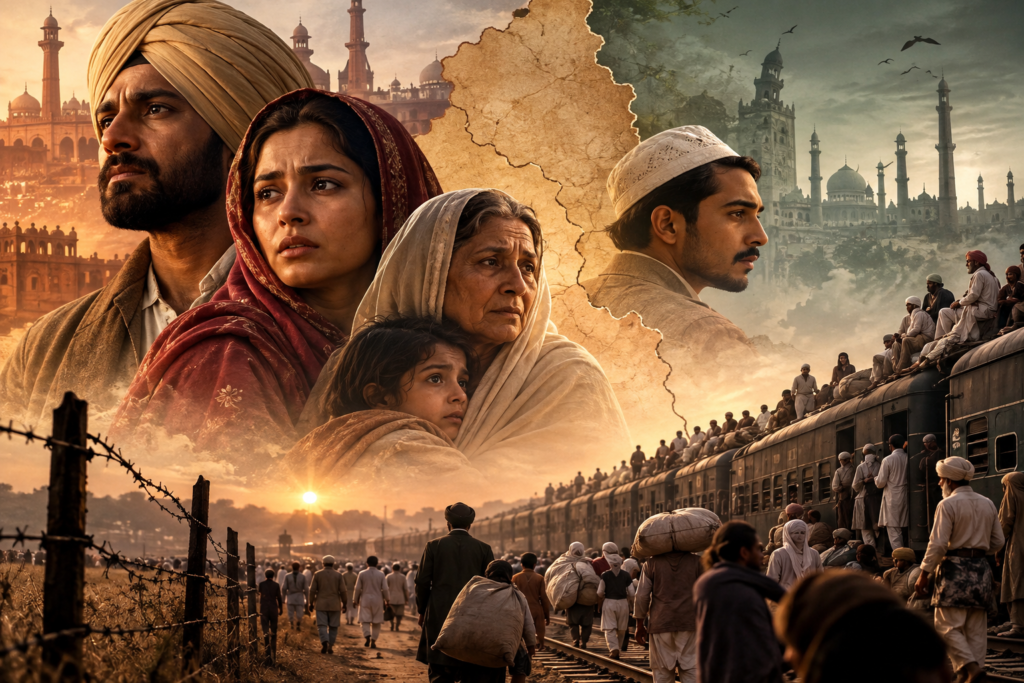
The Partition of India in 1947 remains one of the most important and emotionally difficult events in South Asian history. It divided British India into India and Pakistan, changed borders, separated families, triggered mass migration, and left memories that continue to influence literature, cinema, and popular culture.
For viewers interested in history, human relationships, migration, communal tension, and stories of survival, bollywood movies set during partition offer some of Indian cinema’s most memorable narratives. These films approach Partition from different perspectives, including romance, family drama, displacement, identity, political conflict, and the experiences of ordinary people caught in extraordinary circumstances.
Why Bollywood Movies Set During Partition Remain Important
Partition films are not simply historical dramas. Many of them focus on what political decisions mean for people whose homes, relationships, businesses, and communities suddenly find themselves divided by newly created borders.
The strongest bollywood movies set during partition usually work because they bring history down to a personal level. Instead of concentrating only on political leaders or major events, they show families wondering whether to leave their homes, lovers separated by borders, neighbours divided by religious identity, and individuals attempting to rebuild their lives.
Another reason these movies remain relevant is that filmmakers have interpreted Partition in very different ways. Some films are restrained and realistic, while others use romance, melodrama, action, or literary adaptation to make the period accessible to wider audiences.
For someone exploring Partition through cinema, watching films from different decades is particularly useful. It reveals not only different stories about 1947 but also how Indian filmmakers have changed the way they portray memory, nationalism, migration, and communal relationships.
Best Bollywood Movies Set During Partition to Watch
There is no single definitive Partition movie. Different films emphasize different experiences, which is why a varied watchlist provides a much richer understanding of the subject.
The following titles are among the most notable Hindi and Hindi-language films connected directly to the Partition era or its immediate consequences.
Garm Hava
M. S. Sathyu’s Garm Hava, released in 1973, is one of the most respected cinematic examinations of the aftermath of Partition. Set primarily in Agra, it follows a Muslim businessman and his family as relatives leave for Pakistan while those who remain in India face uncertainty, suspicion, and economic difficulties.
Rather than presenting Partition mainly through large-scale violence, the film concentrates on gradual social and emotional pressure. Balraj Sahni’s central performance gives the story an intimate quality, making the family’s struggle feel personal rather than simply historical.
The film is especially valuable for viewers who want to understand what happened to people who did not immediately migrate. It explores belonging, citizenship, livelihood, family separation, and the difficult question of whether home remains home when society around you has changed.
1947: Earth
Directed by Deepa Mehta, 1947: Earth approaches Partition through relationships between people belonging to different religious communities in Lahore. The film is based on Bapsi Sidhwa’s novel Cracking India and follows events through the world surrounding a young Parsi girl named Lenny.
The story begins with friendships that seem stronger than religious differences. As political tensions increase, those relationships gradually change, showing how fear and communal hostility can transform people who once shared ordinary everyday lives.
Aamir Khan, Nandita Das, and Rahul Khanna are central to the film’s emotional conflict. For viewers looking for bollywood movies set during partition that explore Lahore immediately before and during 1947, Earth is one of the most significant choices.
Gadar: Ek Prem Katha
Released in 2001 and directed by Anil Sharma, Gadar: Ek Prem Katha presents Partition through a large-scale romantic action drama. Sunny Deol plays Tara Singh, a Sikh man who falls in love with Sakina, a Muslim woman played by Ameesha Patel, against the violent background of Partition.
Unlike quieter films such as Garm Hava, Gadar uses mainstream commercial cinema conventions. Romance, family separation, patriotic emotion, action sequences, and dramatic confrontations all play major roles in the story.
Its approach makes it very different from many realistic Partition dramas. Viewers looking for a serious historical reconstruction should keep that distinction in mind, but those interested in how mainstream Bollywood transformed the Partition backdrop into a popular romantic-action narrative will find it particularly relevant.
Pinjar
Pinjar, released in 2003 and directed by Chandraprakash Dwivedi, is based on the celebrated Punjabi novel by Amrita Pritam. The film stars Urmila Matondkar as Puro and Manoj Bajpayee as Rashid and places a deeply personal story within the violence and displacement surrounding Partition.
The story begins before Partition and follows Puro after she is abducted, forcing her into circumstances that dramatically reshape her identity, relationships, and future. The larger political crisis eventually surrounds the characters as communities are displaced and borders are created.
One of the film’s most important qualities is its focus on women. Partition narratives frequently discuss migration and communal violence in broad terms, but Pinjar examines how women could become particularly vulnerable during such upheaval. Its literary origins also give the story a more reflective emotional character than conventional commercial dramas.
Dharmputra
Yash Chopra’s Dharmputra, released in 1961, is an early Hindi film that confronts communalism and the divisions surrounding Partition. Set against the political and social atmosphere leading toward 1947, the story connects communal ideology with complicated family relationships.
The film is especially interesting historically because it appeared relatively soon after Partition compared with many later cinematic treatments. Its themes demonstrate that Hindi cinema was already attempting to examine religious identity and communal conflict while memories of 1947 were still comparatively recent.
Modern audiences may find its filmmaking style different from contemporary historical dramas. Even so, it remains useful for anyone studying how Hindi cinema’s representation of Partition developed across generations.
Hey Ram
Kamal Haasan’s Hey Ram, released in 2000, is broader than a conventional Partition story. Its narrative takes place against the violent political atmosphere surrounding independence, Partition, communal riots, and the assassination of Mahatma Gandhi.
Rather than concentrating exclusively on migration across the India-Pakistan border, the film explores radicalization, grief, revenge, and ideological change. Its protagonist’s personal journey becomes connected to the wider instability of the period.
For viewers building a broader list of bollywood movies set during partition and its immediate historical aftermath, Hey Ram provides a darker political and psychological perspective than romantic films such as Gadar.
Bollywood Movies Set During Partition Based on Literature
Some of the most thoughtful Partition films have literary foundations. This is hardly surprising because writers across India and Pakistan produced novels, stories, poems, and memoirs attempting to understand what Partition did to individuals and communities.
Pinjar comes from Amrita Pritam’s novel of the same name, while 1947: Earth draws from Bapsi Sidhwa’s Cracking India. Garm Hava also has significant literary roots and was developed from a story associated with Urdu writer Ismat Chughtai, with Kaifi Azmi and Shama Zaidi involved in the screenplay.
Literary adaptations often provide a different experience from action-oriented historical films. They tend to spend more time on memory, identity, personal relationships, internal conflict, and the consequences of historical events after the immediate violence has ended.
If your main interest is character-driven storytelling rather than spectacle, literary Partition adaptations are often the best place to begin.
How Partition Is Shown Differently Across These Films
One of the most interesting things about Partition cinema is how differently filmmakers use the same historical period. The backdrop may be shared, but the emotional focus can change completely from one movie to another.
These differences make it useful to watch several films rather than relying on a single cinematic interpretation.
Migration and Displacement
Films such as Garm Hava emphasize the uncertainty created when families must decide whether to stay where they have lived for generations or migrate to another country.
This perspective makes Partition less about political maps and more about losing familiar streets, businesses, neighbours, and extended family networks.
Romance Across Religious Communities
Romantic relationships provide the emotional centre of films such as Gadar and Earth, although the two movies handle those relationships in very different ways.
In these stories, love becomes complicated by religious identity, political violence, changing borders, and pressure from families or communities.
Women During Partition
Pinjar gives particular importance to women’s experiences during the upheaval. Its story examines abduction, family honour, identity, forced circumstances, and the painful decisions created by communal conflict.
This perspective is essential because historical events affect different groups in different ways, and women’s experiences can disappear when Partition is discussed only through politics or military history.
Communalism and Radicalization
Movies including Dharmputra, Earth, and Hey Ram investigate how people who once shared social spaces can become divided by political or religious hostility.
These stories are often most powerful when they show that communal conflict does not begin with strangers. It can break apart friendships, neighbourhoods, families, and relationships that previously seemed secure.
Which Partition Movie Should You Watch First?
The best starting point depends on what kind of film you enjoy. Someone interested in realistic social drama may have a very different preference from someone who wants romance or mainstream entertainment.
A simple way to choose is:
- Watch Garm Hava for a restrained drama about a Muslim family living in post-Partition India.
- Watch 1947: Earth for relationships, communal tension, and the transformation of Lahore during 1947.
- Watch Pinjar for a literary, character-driven story with a strong focus on women and displacement.
- Watch Gadar: Ek Prem Katha for large-scale romance, action, and mainstream Bollywood drama.
- Watch Dharmputra to explore an earlier generation of Hindi cinema dealing with communal identity.
- Watch Hey Ram for a politically and psychologically intense story connected to Partition-era violence and its aftermath.
Watching more than one is worthwhile because no individual movie can represent every experience of Partition.
Are Bollywood Partition Movies Historically Accurate?
Historical films should generally be treated as interpretations rather than replacements for academic history. Even when filmmakers use genuine events and recognizable historical settings, fictional characters, dramatic structure, symbolism, romance, and cinematic storytelling inevitably shape what viewers see.
This is especially important when watching bollywood movies set during partition. The event affected an enormous range of people across different regions, religions, classes, and communities, so one fictional story cannot represent everyone’s experience.
Movies can still be excellent starting points for learning. A viewer who becomes interested in a particular subject—such as migration from Punjab, communal violence in Delhi, refugees in Lahore, or women’s experiences—can then compare the film with books, oral histories, documentaries, and academic sources.
The most useful approach is to appreciate the movies as stories while remembering that historical understanding becomes stronger when multiple sources are considered.
What Makes a Good Partition Film?
A strong Partition film does more than place actors in period costumes or recreate riots. The most memorable examples make historical events meaningful through characters the audience can understand and care about.
Good Partition cinema often includes several qualities: believable personal stakes, attention to the social atmosphere of the period, complex characters rather than simplistic communities, emotional restraint where appropriate, and an understanding that ordinary civilians were often trapped between forces beyond their control.
Another strength is perspective. Films that examine Partition from different viewpoints help audiences understand that it cannot be reduced to one community’s story.
This is why films as different as Garm Hava, Pinjar, Earth, and Gadar continue to appear in discussions of Partition cinema. They approach similar history using entirely different cinematic languages.
Frequently Asked Questions
What are the best Bollywood movies set during Partition?
Some of the most notable choices include Garm Hava, 1947: Earth, Pinjar, Gadar: Ek Prem Katha, Dharmputra, and Hey Ram. The best choice depends on whether you prefer realistic drama, romance, literary adaptation, political cinema, or mainstream action.
For a more serious introductory watch, Garm Hava, Earth, and Pinjar make a strong combination because each examines Partition from a different personal perspective.
Which Bollywood Partition movie is based on an Amrita Pritam novel?
Pinjar is based on Amrita Pritam’s Punjabi novel of the same name. The 2003 film was directed by Chandraprakash Dwivedi and stars Urmila Matondkar and Manoj Bajpayee.
The story explores identity, abduction, family relationships, displacement, and women’s experiences during the Partition period.
Which Partition movie features Aamir Khan?
Aamir Khan appears in Deepa Mehta’s 1947: Earth. The film is set largely in Lahore and follows a group of people whose relationships become increasingly divided as Partition approaches.
Nandita Das and Rahul Khanna also play important roles, and the story is adapted from Bapsi Sidhwa’s novel Cracking India.
Is Gadar based on the Partition of India?
Yes. Gadar: Ek Prem Katha takes place against the backdrop of the 1947 Partition and follows the relationship between Tara Singh, a Sikh man, and Sakina, a Muslim woman.
However, it should be viewed primarily as a commercial romantic action drama rather than as a documentary-style reconstruction of Partition.
Which Partition movie is best for understanding life after 1947?
Garm Hava is one of the strongest choices for understanding the social and emotional uncertainty experienced by a Muslim family remaining in India after Partition.
Its emphasis on housing, business, migration, family separation, and belonging makes it particularly valuable for viewers interested in the everyday consequences of Partition rather than only the violence surrounding it.
Conclusion
The best bollywood movies set during partition show that the history of 1947 cannot be understood only through political boundaries. Behind every border were individuals dealing with lost homes, broken relationships, migration, fear, changing identities, and difficult choices about where they belonged.
Films such as Garm Hava, 1947: Earth, Pinjar, Gadar: Ek Prem Katha, Dharmputra, and Hey Ram approach those experiences from very different directions. Some use realism, others romance or political drama, but together they demonstrate how deeply Partition has influenced Hindi cinema.
If you are beginning to explore the subject, start with films that offer different perspectives rather than searching for a single definitive account. Doing so will give you a broader view of how filmmakers have interpreted one of the most consequential periods in South Asian history.